
Software Defined Networking (SDN): Basic Concepts
Hello folks, welcome back to Learnizo Global. SDN (Software Defined Networking) is a concept that exists for about 20 years. However, only the last few years it has become prevalent in the network community due to the increasing needs in terms of network traffic and programmability that have been driven by the development of other areas, such as mobile devices, network virtualization, and others. Understanding SDN and NFV (Network Functions Virtualization) is the need of the hour for all stakeholders in the present networking and communications industry. In this series of articles, we shall have an insight on SDN basic concepts, SDN Architecture and components of SDN, Open SDN, Software Defined Wide Area Network (SD-WAN), SDN Policy Orchestration, and SDN Security. This article focuses on the basic concepts of SDN.
Why SDN is important in the context of networking and communications?
Over the past decade, both consumers and organizations are increasingly relying on network connectivity for communications, sales, customer service, and document sharing resulting in increased traffic and increased scrutiny.
Until now, the most reliable networks with the highest availability and fastest performance were those built with custom silicon (ASICs) and purpose-built hardware. Software and hardware on these systems were interdependent; software from one vendor cannot run on hardware from a different one unless it’s specifically built to do so.

Because it takes a significant investment to build custom silicon and hardware, rigorous processes are required to ensure vendors get the most out of each update or new improvement. This means adding features without extensive manual configuration is virtually impossible. Customers that want new or different functionality to address their requirements end up following the vendor’s timeline and resources.
Software abstracted from the hardware, however, can be freed from those restraints and adapted without changing the hardware. This flexibility is provided by SDN (Software Defined Networking) and is important for network innovation.
What is SDN?
Software-Defined Networking (SDN) is a network architecture approach that enables the network to be intelligently and centrally controlled, or ‘programmed,’ using software applications. This helps operators manage the entire network consistently, regardless of the underlying network technology.
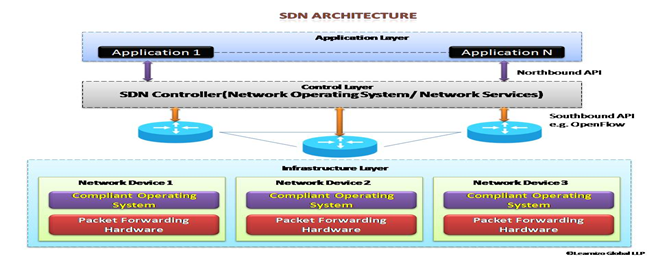
One of the main features that SDN focuses on is the separation of control and data plane. These are the basic components of any network architecture. The control plane refers to the logic of controlling and forwarding behavior. Its main functionalities include tracking topology changes, installing forwarding rules, computing routes, service provisioning, etc. Another basic component is the management plane which refers to the functionalities responsible for configuring, monitoring, and providing management services to all layers of the network stack and other parts of the system. Data plane (also known as forwarding or user plane) refers to the network part that forwards user traffic. Forwarding is based on rules as set by the control plane. Other functionalities related to the data plane are filtering, buffering, packet measurement, etc.
In the case of SDN, the control plane is centralized, controls a distributed data plane, and can be implemented completely in software and installed on the hardware. Therefore, an SDN may be characterized as a programmable network. The idea of programmable networks has been doing the rounds for many years. It refers to networks in which the behavior of network devices is handled by software. Decoupling the control plane from the data plane makes the control plane programmable, thereby enabling abstraction of the underlying network devices from the application and service layers, which in turn treats them as a virtual entity. Besides the network abstraction, the SDN architecture provides a set of northbound (Business Support System) and southbound (Operation Support System) Application Programming Interfaces (APIs) that simplify the implementation of common network services (for example, routing, multicast, security, access control, bandwidth management, traffic engineering, QoS, energy efficiency, and various forms of policy management).
This separation provides a more flexible, programmable, vendor-agnostic, cost-efficient, and innovative network architecture. SDN is one way to solve some problems of the Internet including security, managing complexity, multi-casting, load balancing, and energy efficiency. The separation of the forwarding hardware from the control logic allows easier deployment of new protocols and applications, straightforward network visualization and management, and consolidation of various middle-boxes into software control. Instead of enforcing policies and running protocols on different devices, the network is simplified and reduced to forwarding hardware devices and the network controllers.
What SDN offers
With the abstraction from hardware and all the limitations that a hardware-bound network once had, SDN, NFV (Network Function Virtualization), and NV (Network Virtualization) technologies create networks that can enable innovation, offer new services, reduce CAPEX and OPEX, and deliver fluidity and flexibility.
Organizations can enable innovation with SDN by creating new types of applications, services, and business models in a record amount of time and with less hassle than before. Organizations can create new services and new paths for revenue with dynamic applications and a more efficient workflow. Network functions can be run on less expensive off-the-shelf hardware, reducing CAPEX. Enterprises can reduce OPEX on IT services by supporting automation and algorithm control through increased programmability of network elements to make it simple to design, deploy, manage, and scale networks. Through SDN, these approaches and technologies combined help organizations rapidly deploy new, fluid, and flexible applications, services, and infrastructure to quickly meet their changing requirements.
We will discuss more NFV and NV in our further articles, till then stay safe and happy learning with Learnizo Global.