
Catching up with 5G……. ”LTE Advanced Pro”
This article will introduce LTE Advanced Pro (LTE A Pro). We will discuss the need for an LTE Advanced mobile network to be upgraded to LTE A Pro, offerings of LTE A Pro, and Limitations of LTE Advanced mobile network. In further articles in this series, we will discuss in detail about specifications and technologies to be implemented to make the current LTE Advanced (LTE A) mobile network move from existing constraints to proceed towards 5G.
What is LTE A Pro?
“LTE A Pro is new Radio Access Technology that can be deployed with the existing LTE Advanced mobile network based on 3GPP specifications of Release 13 and Release 14. With LTE A Pro, we can have faster throughput, low latency and support for new services.” Basically LTE-A Pro helps the existing LTE A mobile network to accommodate near 5G services and can be termed as Pre 5G or 4.5 G.
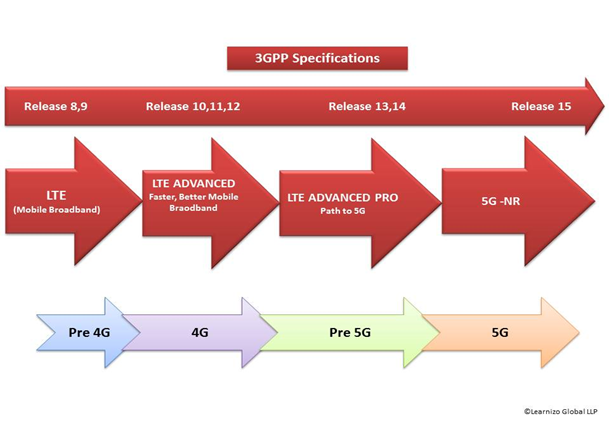
We already have a functional LTE A mobile network that complies with LTE A specifications. This network has been optimized as per LTE A specifications over a period of time for better performance and caters to the growing needs of the industry and businesses. Nevertheless, our hunger to achieve more from the existing setup grows in line with the need of business and technological advancements in use cases. The below points describe this need in detail.
- We need more throughputs and faster mobile network response for mission critical applications.
- We need narrow band access low power devices (NB-IoT, Narrowband Internet of Things) to be able to communicate in the mobile network and to achieve machine to machine M2M communications.
- We need our mobile network talk to vehicles CV2X (Cellular Vehicle to Anything) and keep us informed in the form of warnings and notifications.
- The use of LTE A mobile network for emergency services and public safety is an important aspect we are looking forward to.
We will talk about other mission-critical services, videos, and data services in later articles.
The good news is, we have the technology to cater to the above needs and that is promised by LTE Advanced Pro. It has been deployed for many networks across the world. According to the Global mobile Suppliers Association GSA, as of May 2018, there were 41 LTE-A Pro enabled networks in 30 countries and we are pretty sure that at least 30 more networks have already deployed the technology since then.
Data speeds and bandwidth available for mobile communication will increase significantly using LTE advance Pro. Also, we can have a wider range of connected devices and platforms under a single standard.
Functionality, efficiency capacity, and performance of LTE A mobile network shall be improved and optimized using LTE A Pro. It will further reduce the latency i.e. network response time to provide a better user experience. LTE-A Pro will also ease the introduction of new services to new markets as we move towards IoT with 5G.
Offerings of LTE A Pro and limitations in LTE A
Firstly, LTE A Pro seeks to provide data speeds in excess of 3 Gbps that has a limitation of 1GBps in LTE A. Gigabit LTE with LAA (License Assisted Access) is offered by LTE A Pro based on the basic principle of carrier aggregation already used by LTE A. Up to 3 Gbps of throughput can be achieved using LTE A Pro.
Secondly, LTE A Pro provides 640 MHz of career bandwidth as compared to 100 MHz in existing LTE A networks. LTE A Pro supports advanced carrier aggregation to simultaneously accommodate 32 carriers (channels) in contrast to 5 carriers in LTE A.
LTE A has concerns with a Limited spectrum to cater to the growing needs of subscribers and a growing subscriber base. There exist significant unlicensed 5GHz frequency available and is being used by Wi-Fi networks. LAA and enhanced LAA allow the simultaneous use of licensed and unlicensed spectrum bands to cater for more bandwidth. We will discuss more LAA and enhanced LAA in our later articles.
Thirdly, LTE A Pro provides latency or network response time of 2ms as compared to 10 ms in LTE A. Dynamic uplink and downlink aggregation supported by LTE A Pro will help reduce latency up to 2ms. We shall discuss this in later articles.
Fourthly, LTE A Pro will exploit FD-MIMO (Full Dimension Multiple Input Multiple Output) to simultaneously support elevation and azimuth beamforming to increase capacity and coverage. Using Massive MIMO, the LTE A Pro network can use up to 64 antenna ports at the e-NodeB (LTE Base Station) to cater throughput and latency. We shall discuss this in our later articles.
Upgrade to a new technology requires a nice understanding and thorough knowledge of specifications for stakeholders like mobile network operators other people involved in network planning and maintenance.
Therefore, it is very important to learn the minutest details of LTE A Pro specifications for a smooth transition from LTE A to LTE A Pro.
We at Learnizo global LLP have been into such training worldwide right from the inception of LTE on legacy 3G networks. We have world renowned expertise in Radio Access and Core Network Technologies.
In our later articles, we will provide more Insight on specifications for LTE A Pro from Release 13 and Release 14 of 3GPP, NB-IoT (Narrowband Internet of Things), LTE M (For low power devices that uses M2M communication), CV2X (Cellular Vehicle to Anything), LAA and eLAA, Dynamic uplink and Downlink Aggregation, Aggregation of Small and Microcells using LAA for unlicensed spectrum with dual configuration to reduce latency. Catch up with you in the next article. Stay Safe. Happy Learning with Learnizo Global.