
NFV MANO (Network Functions Virtualization Management and Orchestration)
Hello Folks, Welcome back to Learnizo global. Network Functions Virtualization has changed the way networks are managed. In our previous article, we had an insight on basic concepts of NFV, high-level NFV framework, and benefits of NFV. In this article, we shall understand the NFV MANO (NFV Management and Orchestration)
What is NFV MANO?
NFV management and network orchestration (MANO) plays the management role, right from initial set up to day-to-day operations for a virtualized network. NFV MANO is a framework developed by a working group of the same name within the European Telecommunications Standards Institute (ETSI) Industry Specification Group for NFV (ETSI ISG NFV). Over time, the framework became more commonly referred to as just NFV management and orchestration. It is the ETSI-defined framework for the management and orchestration of all resources in a virtualized data center including compute, networking, storage, and virtual machine (VM) resources. The main focus of NFV MANO is to allow flexible onboarding, sidestepping the chaos that can be associated with the rapid spin-up of network components. NFV MANO is broken up into three functional blocks
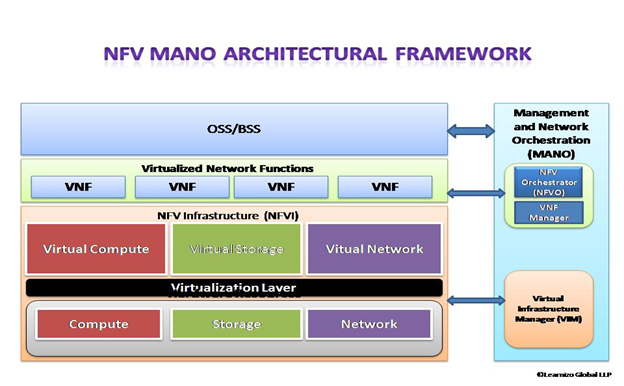
NFV Orchestrator (NFVO)
NFV Orchestrator is Responsible for onboarding of new network services (NS) and virtual network function (VNF) packages; NS lifecycle management; global resource management; validation and authorization of network functions virtualization infrastructure (NFVI) resource requests.
Because virtualized networks can span a large number of networks, software elements, and hardware platforms, NFV orchestration tools must be powerful and able to work with many different standards.
Some of the functions typically required by NFV orchestration include:
- Service coordination & instantiation: The orchestration software must communicate with the underlying NFV platform to instantiate a service, which means it creates the virtual instance of a service on the platform.
- Service chaining: Enables a service to be cloned and multiplied to scale for either a single customer or many customers.
- Scaling services: When more services are added, the orchestration software must find and manage sufficient resources to deliver the service.
- Service monitoring: Tracks the performance of the platform and resources to make sure they are adequate to provide for good service.
VNF Manager
VNF manager oversees lifecycle management of VNF instances; fills the coordination and adaptation role for configuration and event reporting between NFV Infrastructure (NFVI) and Element/Network Management Systems.
Virtualized Infrastructure Manager (VIM)
VIM controls and manages the NFVI compute storage and network resources.
For the NFV MANO architecture to work properly and effectively, it must be integrated with open application program interfaces (APIs) in the existing systems. The MANO layer works with templates for standard VNFs and gives users the power to pick and choose from existing NFVI resources to deploy their platform or element.
In May 2018, Open Source MANO (OSM), a division of ETSI released four standard Features:
- A VNF software upgrade where VNF could be upgraded while the network service is running without impacting it.
- A cleanup of OSM’s northbound API so now only a single pane of glass is needed to control the OSM system.
- Catalog search capabilities are expanded with backing from a common database that stores the state of the system.
- Platform’s improved resiliency to single component failure with techniques like active-standby redundancy.
In our further articles, we will discuss cloud NFV and Open Platform NFV (OPNFV). Till then stay safe and happy learning with Learnizo Global.