
Understanding Kubernetes or K8S
Hello, Folks welcome back to Learnizo Global. Today we will have a brief overview of a pioneer open-source platform for container management and orchestration for distributed applications or cloud-hosted solutions. This platform is Kubernetes or K8S which is currently an exciting and promising technology for cloud-native computing. In this article, we will understand what Kubernetes is, have an introduction to the features it supports and will discuss cloud-native and DevOps use cases of Kubernetes.
Kubernetes, also known as K8S, is an open-source system for automating deployment, scaling, and management of containerized applications.
Containers are self-contained software packages that allow programmers to package part or all of an application into a single object. Kubernetes helps engineers and administrators monitor, manage, and orchestrate these discrete packages within the larger environment. With Kubernetes, responding to failures, managing application configurations, and updating applications can all be automated.
Origin of Kubernetes
The name Kubernetes originates from Greek, meaning helmsman or pilot. K8s as an abbreviation results from counting the eight letters between the “K” and the “s”. Kubernetes is a platform based on Google’s internal container cluster manager, Borg. Because it is based on a Google-designed platform, it is potentially capable of handling workloads at Google’s scale, which is hard to exceed.
Google introduced Kubernetes as an open-source project in 2014. Within a week, many well-known tech companies and open source organizations joined the project. Kubernetes was donated to the Cloud Native Computing Foundation (CNCF), an open-source organization, in 2016. Two years later it was the first project to graduate from the CNCF incubator program. It has a large, rapidly growing ecosystem. Kubernetes services support and tools are widely available.
Kubernetes was created specifically for cloud-native or distributed applications. It can control container instances across servers, making it well-suited for managing complex, distributed systems.
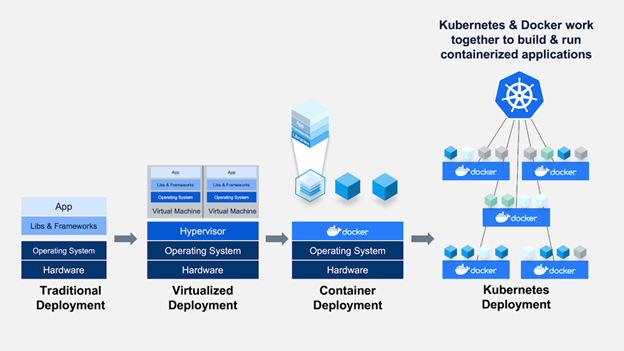
How Kubernetes can help you
With modern web services, users expect applications to be available 24/7, and developers expect to deploy new versions of those applications several times a day. Containerization helps package software to serve these goals, enabling applications to be released and updated without downtime. Kubernetes helps you make sure those containerized applications run where and when you want and helps them find the resources and tools they need to work. Kubernetes is a production-ready, open-source platform designed with Google’s accumulated experience in container orchestration, combined with other useful features added from the open-source community.
Features of Kubernetes
- Service discovery and load balancing – Kubernetes can expose a container using the DNS name or using their own IP address. If traffic to a container is high, Kubernetes is able to load balance and distribute the network traffic so that the deployment is stable.
- Storage orchestration – Kubernetes allows you to automatically mount a storage system of your choice, such as local storages, public cloud providers, and more.
- Automated deployments and rollbacks – You can describe the desired state for your deployed containers using Kubernetes, and it can change the actual state to the desired state at a controlled rate. For example, you can automate Kubernetes to create new containers for your deployment, remove existing containers and adopt all their resources to the new container.
- Automatic Resource Distribution – You provide Kubernetes with a cluster of nodes that it can use to run containerized tasks. You tell Kubernetes how much CPU and memory (RAM) each container needs. Kubernetes can fit containers onto your nodes to make the best use of your resources.
- Self-healing – Kubernetes restarts containers that fail, replaces containers, kills containers that don’t respond to your user-defined health check, and doesn’t advertise them to clients until they are ready to serve.
- Secret and configuration management – In Kubernetes, a “secret“ is an object with sensitive data. A secret gives the user control over how the data is used and accessed. Kubernetes automatically creates secrets with credentials for accessing its API.
Cloud-Native and DevOps Use Cases
The cloud-native and DevOps approaches can gain a lot from Kubernetes. Automation makes the DevOps process more efficient, helping the teams optimize their cloud-native applications.
When developers update an application, the platform creates and deploys new containers incrementally in an automated rolling fashion. Horizontal scaling compensates for the pods taken offline for the update, so application availability never changes. A pod is a collection of containers and is the smallest object in Kubernetes.
While scaling, a minimum and a maximum number of pods can be established in code. A developer should base this scaling on the resource usage of the pods’ containers. When demand on application spikes, the platform auto-scales to keep the application running. When demand drops, pods can be scaled down to avoid idle resource use.
Another aspect of a rolling update is the possibility of faulty code or containers. A developer can set the desired state for a container so that it continues to function in the way the developer wants it to. The platform checks if the containers it controls to match that desired state; if they do not, the containers are pulled from production in favor of the last working version. When the developer has a working updated version ready, the newer version is automatically rolled out as described above.
In our next article, we will understand the Kubernetes Cluster Architecture. Till then stay safe and Happy Learning with Learnizo Global.