
Intent-Based Networking (IBN): Network as a Service
Intent-Based Networking (IBN) : Network as a Service
Hello Folks, welcome back to Learnizo Global. In this article, you will gain insight into a relatively new and emerging technology space that is IBN (Intent-Based Networking). Cisco and Apstra are the leading vendors of IBN at present. IBN aims to apply a deeper level of intelligence and intended state insights to networking. Ideally, these insights replace the manual processes of configuring networks and reacting to network issues. We shall also understand the relationship of IBN with SDN, Dev-Ops, Machine Learning (ML), and advanced automation. Later in the article, we will discuss the architecture considerations and the benefits of IBN.
What is Intent-Based Networking?
“Intent” is the keyword in this technology. It describes a network’s business objective. IT professionals establish policies that specify the network’s business intent, auto-prescribe how to satisfy that goal, and automate at scale.
Traditional networking relied on a command-line interface (CLI) to manually set up policies for all vendors’ networking devices individually. The vendors have a unique interface and syntax for their products, resulting in IT professionals learning the CLI syntax for each vendor’s device to achieve the network’s business objective. IBN approach is vastly different from CLI. IBN operates as a Network-as-a-Service (NaaS), meaning it is end-to-end networking that seamlessly manages all devices on one interface.

IBN is defined as a self-driving network that automatically applies business intent to various network devices across a network without having to rely on a command-line interface (CLI). Instead, the network administrator writes intent in plain language or via a graphical interface. In simple terms, IBN is about telling the software what the business intent is with the software automatically applying the intent across the network.
Intent-based networking is a three-step cycle of translating intent, automating network configuration, and monitoring the intent across the network. IBN isn’t a sole technology by itself, it involves orchestration policies to automate configuration to an already existing software-defined networking (SDN) technology in a network infrastructure.
Sasha Ratkovic, Apstra’s CTO and co-founder, has written that to qualify as IBN a technology must meet several requirements:
First, it must be based on a single source of truth with the state represented in a graph that captures all the relationships between all the various layers.
The first requirement is a prerequisite for the second – It must include real-time, continuous validation of all aspects of customer intent – across network connectivity, performance, and security.
The second is a prerequisite for the third – It must have the ability to self-heal.
How IBN relates to AI, ML, SDN, and Dev-Ops
Artificial intelligence (AI) and machine learning (ML) are involved in the translating, configuring, and monitoring process. The technologies enable IBN “to analyze data, extract information from data and learn from it automatically, without being explicitly programmed.”
IBN is achievable through orchestration and machine learning (ML). Together, the two technologies create a closed cycle that constantly refreshes and applies the intent.

IBN is not designed to work on its own. It is an addition to software-defined networking (SDN) that brings automation to network configuration. SDN is important to IBN because virtualization is required for IBN to provide its benefits and have one interface control an entire network. The network that follows IBN consist of software-based devices that have been virtualized based on the design of SDN architecture.
While Intent-based networking is compared with software-defined networking (SDN), it also contrasts in a few distinctive ways. Mainly, intent-based networking adds Dev-Ops, and it allows network operators more control over running the network.
IBN and Advanced automation
Advanced automation and IBN, both technologies resemble each other however there are remarkable differences between them. Advanced automation solutions typically do not
a) -translate what to how
b) -mathematically validate that desired intent is being met and
c) -continuously ingest a broad set of real-time network state indicators. A good intent-based networking system will embed advanced automation, but you can (and many do) advanced automation without Intent.”
Considerations for IBN Architecture
The Open Network User Group (ONUG) describes IBN as a different perspective of what a network is and how it can operate. It’s “moving beyond viewing the network as routing, switching, wireless to Campus, WAN, Data Center, and Cloud; instead, it’s a broader strategy to revamp the entire network portfolio.”
Below are the key considerations when implementing IBN architecture:
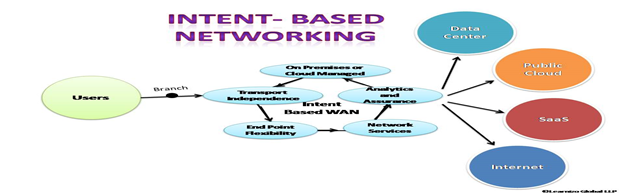
- Analyze each networking project and define if intent-based networking can be added to those projects before implementing IBN into the network architecture.
- SDN is important to IBN because there is no need to invest in new technology as IBN can be added to already existing SDN technology. Attach orchestration policy-based automation, either to single domains or multiple domains, to successfully implement IBN into the networking architecture.
- Ensure robust and thorough monitoring and assurance are in place.
- Understand that artificial intelligence (AI) and machine learning (ML) are involved in the translating, configuring, and monitoring process. The technologies enable IBN “to analyze data, extract information from data and learn from it automatically, without being explicitly programmed.”
- The Enterprise Strategy Group advises that “to really maximize the benefit of intent-based networking, IT needs to implement comprehensive, end-to-end architectures across all domains, such as DC, campus, branch extended enterprise, cloud, etc.”
- The network architecture should have security already in place, but it needs to also encompass the IBN components. Verify that the security protocol in place will safeguard the IBN component.
- Review the application programming interfaces (APIs) in the network architecture to determine if they will work with IBN.
The Benefits of Intent-Based Networking
- Increased agility and availability
- Vendor-neutral — IBN will work across all devices from different providers
- Improved control and performance. As administrators input the defined intent, the software decides the best way to implement that intent across the network.
- Self-Service — It allows for real-time updates and monitoring.
- Security detection — Detects security issues in real-time.